
More than half a dozen companies will hit the market with their initial public offerings (IPOs) between now and the end of next week. The cumulative amount raised from these IPOs is expected to be around Rs 8,000 crore. Stationery products firm DOMS Industries and home financier India Shelter Finance's IPOs - of Rs 1,200 crore each - got off to a flying start on Wednesday (December 13), with the former garnering over six times the subscription and the latter getting 1.5 times subscribed.

Fundraising through qualified institutional placement (QIP) has revived this year, led by commercial banks, after a lacklustre 2022. According to data compiled by Prime Database, Indian companies have raised Rs 53,070 crore in 2023 so far, of which seven banks - Union Bank of India, Indian Bank, Bank of India, Federal Bank, IDFC First Bank, Bank of Maharashtra, and J&K Bank - account for Rs 21,290 crore, or about 40 per cent. If other financial institutions are included, the figure surges to Rs 26,690 crore.

Global private equity (PE) firms are successfully offloading large equity stakes in domestic companies in the open market, taking advantage of buoyant conditions. Strong domestic liquidity support and an upward trending market have underpinned over a dozen PE exits worth $2.5 billion, data compiled by Business Standard shows. The figures exclude PE exits during maiden share sales and shares sold by strategic investors, such as SoftBank and Ant Group in new-age companies.

The verdict in the Google versus Epic Games antitrust case in the US has spread cheer among the Indian gaming and app developers. Ending a three-year legal battle, the San Francisco jury found that Google turned its Play app store and billing service into an illegal monopoly. American video game maker Epic Games, best known for Fortnite, had sued Google in 2020.

'With free software on the Internet and apps, creating a deepfake video can take 3 to 5 minutes. Anyone can make these videos.'

The domestic equity markets are expected to extend gains following the strong showing of the Narendra Modi-led Bharatiya Janata Party (BJP) in the state elections - a crucial precursor to the general elections in May. The BJP decisively secured victories in three of the four key states - Madhya Pradesh, Rajasthan, and Chhattisgarh. While the battles in these three states were closely contested, the scale of the BJP's triumph has surprised many, heightening expectations for regime continuity in 2024 - a positive catalyst for the markets.

India Inc's net profit as a percentage of the country's gross domestic product (GDP) is just shy of reaching 5 per cent, bolstered by strong earnings growth in the second quarter of 2023-24. Analysts interpret this as an indication that a corporate profit upcycle is in progress, with projections suggesting that this share could exceed 8 per cent within the next five years, driven by bullish earnings growth expectations. "We believe we are only halfway through a profit cycle, with the profit share in GDP rising from a low of 2 per cent in 2020 to about 5 per cent currently, and likely heading to 8 per cent in the coming four to five years. "This implies about 20 per cent compounding of earnings growth. "Underscoring this forecast is the start of a new private capex cycle, under-geared balance sheets, a healthy banking system, lower corporate tax rates, improving terms of trade, and structural consumption demand outlook albeit somewhat offset by likely consolidation in government deficit," said Ridham Desai, managing director, head of research, Morgan Stanley India in a note.

Her reasoning is simple, "It's a Tata company. No shareholder will let go of this opportunity," she told Business Standard. When asked if the other reason for lining up for the IPO is the technology sector and the fact that the combination of Tata and tech is happening after almost two decades, she replied: "The name of the company and the group matter. Tata means stability and credibility," she added.

Equity markets rallied after softer-than-expected inflation data in the US and UK rekindled hopes of the end of the rate-hiking cycle by major central banks. The soft inflation reading drove down bond yields and the US dollar, whetting the appetite for risky assets. The 10-year US bond yield fell below 4.5 per cent after topping 5 per cent less than a month ago.
Diwali fireworks are expected to continue on Dalal Street next week, with four companies collectively seeking to mobilise over Rs 6,600 crore through initial public offerings (IPOs). In terms of the amount raised, this is poised to be the busiest week of calendar year 2023. Tata Technologies (Tata Tech), a subsidiary of Tata Motors, could lead the charge with an IPO projected to be over Rs 2,900 crore. This will mark the first maiden share sale by a Tata Group firm in nearly two decades.

'...similar to the 2008 global financial crisis, the 2012 taper tantrum, or the 2018 midcap crash.' 'This could lead to a substantial decline in activity and revenues for the broking industry.' 'When this will happen is uncertain, but as brokers, we must be prepared for such a downturn.'

Domestic investors are tightening their grip on the ownership of listed companies. The gap between the shareholding of domestic institutional investors (DIIs) and foreign portfolio investors (FPIs) narrowed to 13.11 percentage points at the end of the September 2023 quarter. At the peak, the gap was nearly 50 percentage points in March 2015, according to an analysis by Prime Database, a leading provider of data on the capital market.

For Lori Beer, chief information officer, JPMorgan Chase & Co, largest banker in the US, India is a big part of the organisation's global technology footprint and is core to its products and services. This is evident from the fact that in less than two months since JPMorgan & Chase chief executive officer Jamie Dimon visited India, Beer has come here to see the recently opened centres in Mumbai and Bengaluru. "What is different for me this year are our new centres and to be able to come and see the vibrancy, and connectedness is great.
In the current calendar year, small and medium enterprises (SMEs) have witnessed an impressive surge in initial public offerings (IPOs), surpassing the 2018 record. Over 150 SME IPOs have been introduced to the market, breaking the previous record of 141 set in 2018. According to data from PRIME Database, a primary market tracking firm, 147 companies successfully concluded their debut share sales by the end of October, raising a cumulative Rs 3,727 crore.

'Our Q1 was almost flat, and there was very negligible growth in Q2, but the deal pipeline and the order book have been fairly significant.'

'We will have a strong exit as our third quarter is strong.'
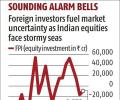
Foreign portfolio investors (FPIs) have withdrawn Rs 25,305 crore from domestic markets since September. FPIs were net sellers in the first two months of 2023, but from March to August, they purchased equities worth Rs 1.7 trillion. This selling trend has caused the National Stock Exchange Nifty Index to decline by 3.2 per cent from its September highs. FPI selling initially began in September as profit-taking but intensified due to rising US bond yields and uncertainty regarding the rate hike trajectory.

Draft Red Herring Prospectus (DRHP) filing continued to be robust in October, signifying the optimism in the initial public offer (IPO) market despite the recent turbulence in equities. In October, 17 companies filed their offer documents for IPOs. The rush in filings has made August-October 2023 the best three-month period for DRHP filings since July-September 2021.

The fees charged by investment banks to manage initial public offerings (IPOs) have increased to an average 3.23 per cent of the issue size this calendar year, the highest since 2020. The average fee is up 8 per cent compared to last year, when it stood at 2.99 per cent. The investment banking fees have increased as the average IPO size has shrunk this year.

TCS saw its headcount reduced by 6,333. Infosys' headcount decreased by almost 7,500, and HCLTech saw its employee numbers shrink by 2,299.
 © 2026 Rediff.com - Investor Information - Advertise with us - Disclaimer - Privacy Policy - Sitemap - Feedback - About us - Terms of use - Grievances